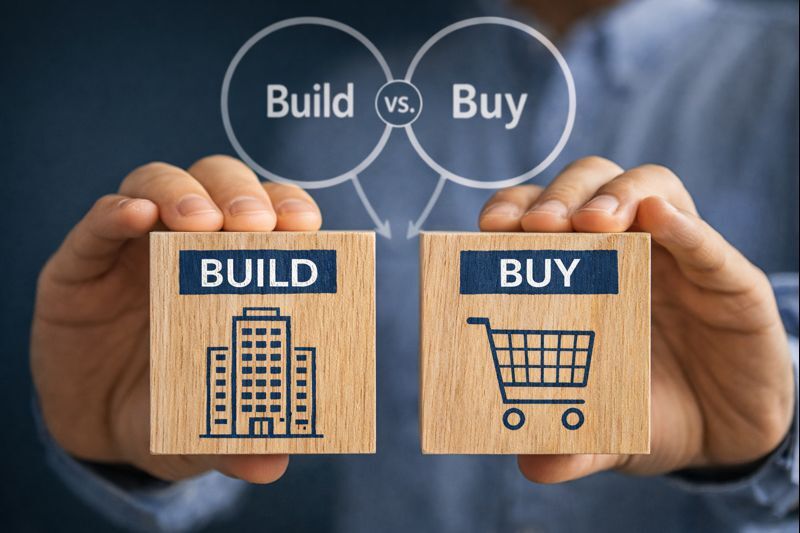
The build versus buy question is one of the most consequential technology decisions a small business can face - and it comes up more often than most people expect. Whether you're trying to automate a workflow, manage customers, or streamline operations, you'll eventually hit a fork in the road: do you invest in custom software built around your exact needs, or do you adopt an existing platform and work within its boundaries?
There's no universal right answer. But there is a framework for thinking it through clearly.
Why This Decision Matters More Than You Think
Most businesses underestimate the long-term cost of the wrong choice. Buy a platform that can't scale with you, and you'll eventually pay to migrate. Build something prematurely, and you'll burn budget and time before you've validated that the process even works. The goal isn't to pick the "better" option, it's to pick the right option for where your business is right now.
The Case for Building Custom Software
Custom development makes sense when your needs genuinely can't be met by what's already on the market. Here's when it's worth the investment:
-
Your workflows are unique. If your business processes are specialized, niche, or deeply intertwined in ways that off-the-shelf tools simply weren't designed to support, a custom build eliminates the friction of forcing your operations into someone else's template.
-
You need full ownership and control. Custom software means you own the source code, the data, and the roadmap. You're not at the mercy of a vendor's pricing changes, feature deprecations, or platform shutdowns.
-
Security or compliance requirements are strict. Industries with sensitive data like healthcare, legal, and finance often have requirements that standard platforms can't fully satisfy, especially in this AI, cloud-based world. A custom application gives you precise security governance control.
-
You're building a competitive differentiator. If the tool you're building is part of your competitive advantage - not just an internal utility - that's a strong signal to build.
Best suited for: Established businesses, specialized industries, or companies scaling rapidly who need to automate deeply and can support the longer development cycle.
The Case for Buying an Existing Platform
For most small businesses, especially early-stage ones, buying wins on speed and economics.
-
You need to move fast. Platforms like HubSpot, QuickBooks, or project management tools can be live in days. Custom builds take weeks or months at minimum.
-
Upfront costs matter. Subscription software spreads cost over time and eliminates the need for a dedicated development budget. For a lean business, that predictability is valuable.
-
You'd rather not maintain it. With a vendor, updates, security patches, and bug fixes are someone else's problem. That's not a minor thing, ongoing maintenance is often the hidden cost that kills custom builds.
Best suited for: New businesses, small teams, or anyone who values speed, simplicity, and a lower barrier to entry.
Side-by-Side Comparison
|
Factor
|
Build
|
Buy
|
|
Speed
|
Longer to launch
|
Quick deployment
|
|
Cost
|
Higher upfront; ongoing dev costs
|
Lower upfront; subscription fees
|
|
Flexibility
|
Fully customizable
|
Limited to vendor roadmap
|
|
Support
|
Your responsibility
|
Vendor handles it
|
|
Scalability
|
Scales with your business
|
May outgrow the platform
|
|
Security/Compliance
|
Strict requirements
|
Standard requirements
|
|
Ownership
|
Full control of code & data
|
Vendor-dependent
|
The Option Most Businesses Overlook: Hybrid
Not every decision is binary, and the most pragmatic path is often somewhere in the middle.
A hybrid approach layers customization on top of existing platforms. With this approach you get the speed and cost advantages of off-the-shelf tools while still tailoring the parts that matter most to your business. This looks like:
- Customize within a platform. Build tailored automations, client portals, or reporting dashboards on top of tools you already use, like HubSpot or QuickBooks.
- Connect across platforms. Custom integrations or automation logic that bridges gaps between your existing tools, extending their life without replacing them.
For many small businesses, this is the sweet spot: you're not starting from scratch, but you're not constrained by a vendor's vision of how your business should work.
The Questions You Should Be Asking
Before you decide, work through these:
- What specific problem am I trying to solve, and is it actually unique to my business?
- How quickly do I need a working solution?
- What will this cost over 1, 3, and 5 years (including maintenance, upgrades, and team time)?
- Am I comfortable depending on a vendor long-term?
- Is there a realistic chance I'll outgrow this tool in the next few years?
The answers won't always point clearly in one direction, but they'll surface the trade-offs that matter most for your situation.
The Bottom Line
The right choice depends on your goals, budget, timeline, and how standard (or unique) your processes actually are. What works for a 200-person company won't necessarily work for a 5-person team, and what's useful today may not be right in three years.
At Blue Aurora Solutions LLC, we help small businesses evaluate both paths honestly and design solutions that fit where you are and where you're going - whether that's implementing the right platform, building custom solutions, or finding a hybrid approach that gets you the best of both worlds.
Ready to evaluate your options? Schedule a free, no pressure, intro call with us here: https://calendar.app.google/WYftZq4ngUiz9JZK9


-1.png?width=1920&height=960&name=Untitled%20design%20(2)-1.png)